


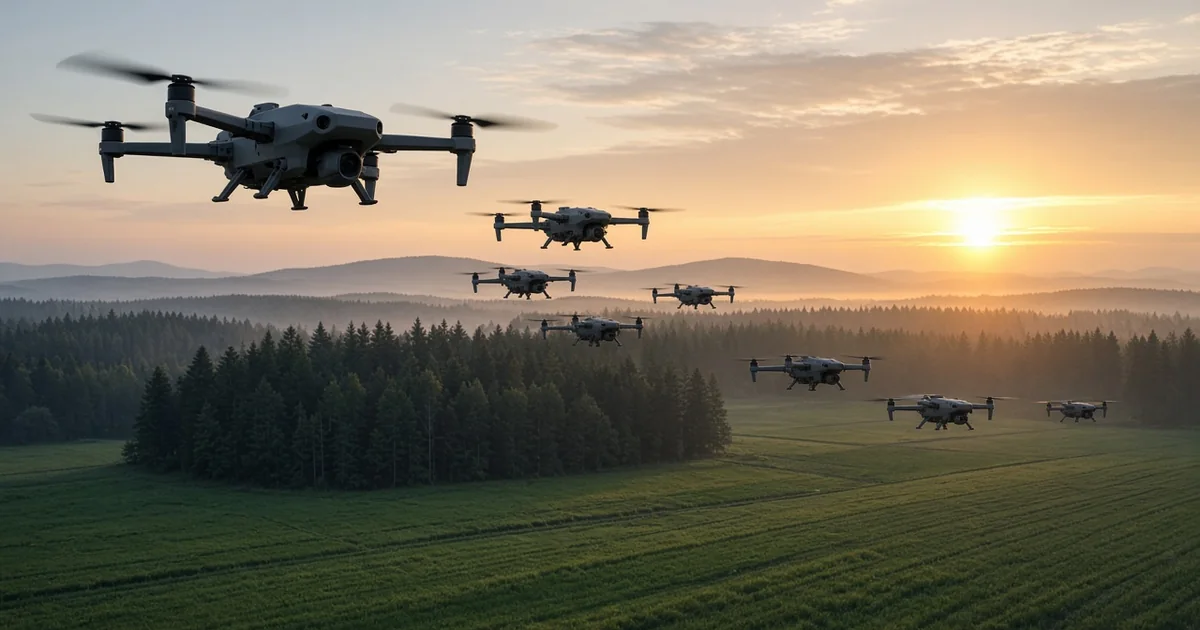
Bergen (Lower Saxony). Federal Defense Minister Boris Pistorius has announced that the Bundeswehr will create its own drone regiment for the first time in 2027 — as a direct response to the experience of the war in Ukraine, where a significant share of devastating strikes comes precisely from unmanned systems. This was reported by tagesschau on October 1, 2026.
The minister made the statement during a visit to the Bergen training area. According to him, anyone who wants to win on land must master combat with unmanned systems. Berlin is now transferring the lessons from the Ukrainian front into the structure of its own armed forces.
What exactly is planned
The regiment is to cover ranges from close combat to about 500 kilometers. This involves not only flying drones but also unmanned ground systems. Pistorius separately emphasized: the regiment will include its own electromagnetic warfare company — a critical capability in modern warfare, where electronic jamming often decides the outcome of a strike.
Inspector of the Land Forces, Lieutenant General Christian Freuding, clarified the numbers: an initial start of approximately 300 service members, with a target strength of up to 600. The base location has not yet been determined. In parallel, unmanned systems will continue to be integrated into existing branches of the armed forces — infantry, reconnaissance, and tank units.
Kamikaze drones and the brigade in Lithuania
The new regiment is also to be armed with kamikaze drones (so-called loitering munitions). In the Bundeswehr, these systems are currently undergoing testing and, according to the plan, are to reach the troops next year.
A separate task is to prepare the 45th Brigade, designated for Lithuania, for countering drones even before its relocation. This directly concerns NATO's eastern flank and the security of the Baltics — a region that has remained at the center of Berlin's attention since the start of the full-scale invasion of Ukraine.
Why this matters for Ukrainians in Germany
The decision on the drone regiment is a political and military signal: Germany officially recognizes that the war in Ukraine has changed the standards of land warfare and is adapting its own defense to these realities. For the Ukrainian community in Germany, this is another indicator that Berlin perceives the conflict not as a "distant" story but as a source of lessons for European security — from the Baltics to German training grounds.
This material was prepared based on a tagesschau report dated October 1, 2026. The text is an independent Ukrainian retelling, not a verbatim translation.