


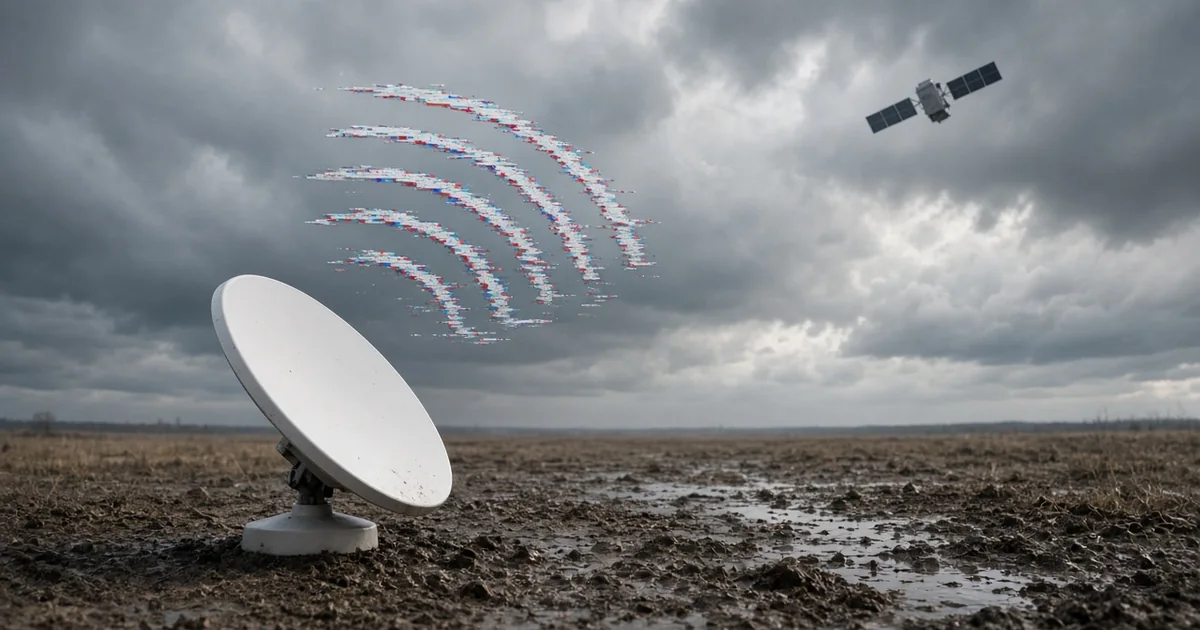
After the diesel deal between Donald Trump and Vladimir Putin, open threats against Ukraine, and missile strikes without warning from Kyiv's allies, Kyiv has faced yet another problem: restrictions on the operation of the Starlink satellite internet service owned by Elon Musk's company SpaceX. For many in Ukraine, this looks not like a technical glitch, but like political pressure.
"This is no coincidence"
Security expert Mykhailo Samus, director of the New Geopolitics Research Network, said in an interview with ARD that the American authorities are "cynically" using various levers to force the Ukrainian president and society into capitulation. In his view, Trump and Putin are primarily concerned with business and enrichment, and a "defiant" Ukraine merely gets in the way.
"The longer this goes on, the more obvious it becomes," Samus adds. At the same time, he emphasizes that for Europeans, values are not just about money — "at least one wants to believe that."
Europe is the main partner
According to ARD correspondent in Kyiv Rebecca Barth, Europe has already become Ukraine's most important partner — militarily, economically, and diplomatically. The attacked country no longer relies on the US the way it once did.
President Volodymyr Zelensky, in a conversation with Reuters, sounded restrained and disappointed: "The US and Russia are interested in deals. I am confident they want to implement energy projects. And this, of course, is difficult for them as long as the war in Europe continues."
Many in Ukraine perceive Trump's behavior this way: they want to "solve the Ukraine problem" by giving it away. Europe is trying to compensate for the missing American aid, but recent days have clearly shown the weak points of this dependence.
What happened with Starlink
Since the start of the full-scale war, the Ukrainian army has used Starlink for communications at the front, where infrastructure is destroyed and there is no mobile internet. Recently, drones and naval unmanned vessels have also been controlled via the satellite channel, and video is transmitted in near real time.
According to Ukrainian media reports, on Wednesday night SpaceX introduced speed restrictions for terminals without warning: aircraft lose connection if they move faster than about 160 km/h (according to other data — from 110–120 km/h). For long-range drones that fly at up to 300 km/h, this effectively means "blind" flight without remote control.
Military expert Mykola Melnyk explains the consequences bluntly: America has deprived Ukraine of the ability to strike Russian logistics in the rear with drones. "This is a very bad development," he says.
Elon Musk himself stated on social media X that the restrictions are imposed not by him but by the US government: Starshield systems belong to Washington and are controlled by it. The White House initially did not respond to tagesschau's request; Trump rejected accusations of reducing intelligence sharing.
Connection partially restored
Ukraine's Ministry of Defense reported that after intensive negotiations, including with the US, Starlink can again be used as before — at least for receivers at speeds of up to about 160 km/h. According to the ministry, SpaceX is still holding to a limit of about 161 km/h, and Kyiv continues dialogue about stable operation.
In the evening, ballistic missile threat alerts appeared again in the capital — a reminder of how critical timely intelligence and reliable communications remain.
Based on materials from tagesschau.de, 15–16.10.2026 (Rebecca Barth, ARD Kyiv).